Crystal Shapes
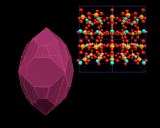 |
Perhaps the most characteristic feature of the crystalline state is the well defined shape or morphology of crystals. What determines the morphologies of crystals? Or, to put it another way, which surfaces will be the most important in the real crystal? Many attempts have been (and are still being) made to answer this question. Here we will look briefly at two approaches: the first is based on the energies of surfaces. Forming surfaces obviously costs energy as bonds are broken when the crystal is cleaved, although some of this energy will be regained when the crystal surface relaxes as described in the previous section. And since we can model surface structures, we can also calculate surface energies. Higher energy surfaces, that is those that cost more in energy terms to make, would be expected to be less important; or, to put it the other way round, those surfaces with low energies will be dominant in the observed crystal morphology. This idea can be put onto a firm quantitative mathematical basis, and allows us to predict crystal morphologies. An example is shown on the below.
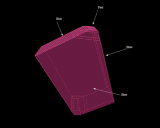
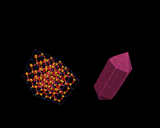
An alternative (and often more realistic) approach is to investigate the energies involved in laying down additional layers of atoms onto a pre-existing surface - the so-called 'attachment energy'. We might expect that the higher such an energy, the greater the rate at which atoms will be deposited on that surface. A little thought shows, however, that the surface which is growing rapidly will not be important in the resulting crystal morphology; for as shown schematically on the left, as it grows, it exposes other surfaces. This model would indeed lead us to expect that the prevalence of surface will be inversely dependent on the attachment energy. Once again, the attachment energy can be calculated and the theory can be made quantitative. The image on the left shows resulting predicted morphologies for the case of quartz, which may be compared with the shape of a real quartz crystal. The level of the agreement is gratifying.
 |
 |
Crystal growth is, however, a highly complex phenomenon and the two approaches described above are only approximate guides to help us understand the possible shapes that crystals might adopt. The study of these and related processes is a very active field in contemporary materials science research.