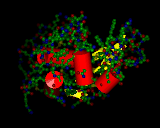
The structure of the enzyme lysozyme.
|
We have always needed models to understand the complex world
in which we live. Models allow our minds to
safely explore reality; and models
scale tiny and huge objects to a size that we can
comprehend and become familiar with. Models are therefore
essential in the scientific quest for a rational
understanding of the physical universe. Visualization is,
moreover, an immense aid to the scientific imagination,
as it seeks new relationships and connections between
concepts and phenomena - the process which is at the
heart of scientific discovery.
Models have been used since the beginning of scientific
thought, and some of the earliest and most detailed
scientific models relate to astronomical observations.
The earth centric cosmologies of the ancient world were
perfected in the Ptolemaic system of the universe. This
highly complex and beautiful structure explains a wide
range of observations on the motions of planets and
stars. The Ptolemaic system was of course swept away by
the Copernican revolution in the 16th century, which
produced far simpler heliocentric models for the solar
system; these explain astronomical data more
straightforwardly and could subsequently be rationalized
by Newton's gravitational theory.
A snapshot from a simulation of the formation of a spiral galaxy.

|
In astronomy and
cosmology, which are among the most enduring scientific
grand challenges, models are therefore crucial. 'Global
modeling' is also playing an increasingly important role
in new sciences that aim to understand how the earth's
atmosphere, oceans and interior work. Their role in
engineering and applied sciences is obvious, but
contemporary technology is expanding enormously their
range and sophistication. For example, the complex
model of the distribution of pressure over the wings of a
fighter aircraft in flight; and detailed and accurate
information of this type is, of course, a valuable design
tool in the aerospace industry. Our emphasis here is,
however, on the role of models in understanding matter at
the microscopic level - the world of atoms and
molecules - and in revealing the marvellously varied
ways in which atoms combine to give structures of immense
complexity and beauty; structures that support life like
the enzyme lysozyme above whose atomic architecture was first
elucidated at The Royal Institution in 1965.
And structures which
lead to extraordinary and technologically important
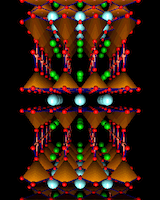
properties, such as the high temperature superconducting
material whose crystal structure is shown below.
While the symmetry and
elegance of molecular structures is illustrated by the
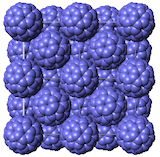
spherical carbon molecules of 'Buckminster Fullerene' materials.
Note: There is additional information on galaxy formation simulation linked here. The essence of the simulation is illustrated above. A circular region of space is defined as shown on the left and divided into a collection of rings and areas within each of these rings. At each time step in the simulation the regions next to active regions have a finite probability of becoming active. This simulates the initiation of star formation caused by the explosion of a nearby supernova where the shockwave precipitates the condensation of hydrogen clouds into the seeds of star formation through gravity. (You can expand the image by clicking on it).
The crystal structure of carbon C60 Buckminsterfullerene.
|
The crystal structure of a high temperature superconductor.
|