Molecules In Our Lives
|
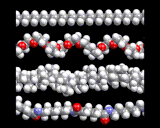
Molecular structure is of central importance for our everyday lives. Before we explore molecular structure, we explore the nature and structure of atoms. We show how, with the aid of the computer, we can understand how these complex (and unbelievably tiny) objects bind together to form molecules - the problem that is at the heart of chemistry. Molecules use simple geometrical tricks - chain and ring formation - to achieve complexity. We then consider the aggregates of molecules and the fascinating question of the balance between order and disorder at the atomic and molecular level. Consideration of order will lead to describing how in crystals nature builds beautiful, ordered (if often very complex) structures in three dimensions; while disorder takes us naturally to structures of liquids and glasses. Three dimensional objects like crystals are bounded by a surface; models for surfaces and interfaces are the subject of this section. And consideration of surfaces leads us naturally to discuss films and membranes that play such important roles in technology and living matter. Molecules and other atom assemblies are, of course, omnipresent. The pen used to write the draft of these words and the paper on which they were written were made out of molecules: chain molecules, molecules whose typical structures are illustrated below.
However, molecules are not static objects: they are in constant motion; vibrating, rotating or translating. So when I feel a breeze on my face, unimaginable numbers of molecules are colliding with my skin; and when a solid melts, the molecules that were previously fixed at particular sites in the solid, are able to move, to wander through the liquid. Molecules change: they lose and gain atoms; they break up and reform, and as they do so they gain or lose energy. So when we light natural gas which is made from the simple molecule methane, the molecule breaks up and forms new molecules - carbon dioxide and water - by combining with the oxygen atoms from the air; and energy in the form of heat is given out, as is light. When metal rusts, the atoms from the crystalline metallic solid again combine with the oxygen from the air to make a new crystalline material - an oxide - which has very different physical and mechanical properties from that of the metal.
 |
Molecules and molecular processes are always with us. As we have just seen, the molecule carbon dioxide is produced by burning gas and other carbon containing fuels. It is the end product of combustion - a chemical reaction which unlocks the energy stored in molecules like methane. The carbon dioxide enters the atmosphere. But it has the key property of being able to absorb the heat carrying infra red radiation emitted from the earth's surface. So it acts as a blanket, keeps this heat in the atmosphere; and as carbon dioxide accumulates owing to the increased generation of energy by burning fuels, the atmosphere warms. The ability of carbon dioxide to absorb infra red radiation is a consequence of its molecular structure. The radiation excites vibrations in the molecule; and as it does so, the energy of the radiation is absorbed. Many other molecules, including methane and water, also absorb this type of radiation.
Ozone is another molecule that plays a crucial role in controlling the transmission of radiation through the atmosphere. The molecule is built out of three oxygen atoms (unlike "ordinary" molecular oxygen that simply comprises two atoms stuck together). Unlike CO2 that absorbs the low energy, heat carrying radiation, ozone absorbs the high energy ultra violet radiation present in the sun's rays. And the "ozone layer" high up in the earth's atmosphere protects the surface of the earth by absorbing a high proportion of this damaging radiation. Ozone can, however, easily decompose; the molecules rearrange to form "ordinary" molecular oxygen. This decomposition is helped by reactive atoms such as chlorine. Such reactive atoms are not normally present in appreciable concentrations in the earth's atmosphere. They are, however, made by the action of sunlight on chlorine containing molecules known as CFCs, widely used in refrigerators, as they form volatile liquids at low temperatures. Many of these molecules have leaked into the earth's atmosphere and reached the stratospheric heights where they have decomposed, releasing chlorine atoms which have depleted the ozone layer. Fortunately, the chemical industry has now succeeded in designing replacements for CFCs that do not have these environmentally damaging consequences.
Molecules and molecular processes control our lives; indeed, as we shall discuss later in this book, life is a molecular process. But there is nothing magical about the molecules of life. They can be understood using the same principles as are applied to all molecular species. These molecules and the processes that they support have been selected and fashioned by billions of years of evolution to achieve the balance of simplicity and complexity necessary to achieve precise biological functions.
John Tyndall - one of the physicists who both developed scientific knowledge and communicated that knowledge to the public - pointed out in 1870, in an address to the British Association, considering among other matters the growth of living tissues, that:
"An intellect the same in kind as our own would, if only sufficiently expanded, be able to follow the whole process from beginning to end. It would see every molecule placed in its position by the specific attractions and repulsions exerted between it and other molecules, the whole process and its consummation being an instance of the play of molecular force."
With the aid of the of modern computers, and computer graphics we are beginning to realize Tyndall's dream, simulating, tracking and visualizing every molecule to understand how the universe works.