Forces Between Molecules
 |
We have seen that when two or more atoms come together they can form chemical bonds because the electron charge clouds interact and density in the outermost portions is redistributed. What happens, however, when the molecules interact? Of course, as we saw earlier, they may react; the bonding patterns rearrange and the atoms find new partners. New molecules are formed. But molecules will interact even when they are not forming new chemical bonds. And these 'non-bonding interactions', although perhaps less exciting than chemical bonding, are equally important, and control many of the most important phenomena in nature.
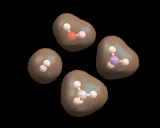
Let us look at the origins and types of these interactions. The first and simplest are non-bonded repulsions. Obviously if two molecules get too close together, they will repel each other: both the nuclei and the electrons will interact and they will push each other apart. In fact it is these repulsions which really define the size of the molecule, because they define the space around a molecule from which other atoms and molecules are excluded.
Non-bonded attractions between molecules are of two main kinds. The first arise from the fact that atoms in molecules commonly have significant charges. So positively charged atoms on one molecule will be attracted to negatively charged atoms on a second molecule. The classic (and extreme) example of the effect arises when we have bonding between hydrogen and (highly electronegative) atoms such as oxygen, nitrogen and fluorine. These latter atoms pull charge towards them giving a very polarised bond with a positively charged hydrogen atom, which will have to stick to the negatively charged atoms of different molecules. This strong attractive intermolecular interaction is known as the hydrogen bond. It is one of the most important forces in nature. Indeed, the world as we know it and life itself would not be possible without the hydrogen bond. It is the main force acting between water molecules and, indeed, is responsible for water being a liquid rather than a gas; so without hydrogen bonding we would have no oceans. It is also a force which plays a crucial role in the chemistry of proteins and of DNA as we will learn later; so without hydrogen bonding there would be no life.
The other form of attractive interaction is more subtle, and arises from a special kind of phasing or correlation between the motion of electrons. If we allow ourselves for a moment to think of atoms and molecules using the ideas of classical physics, we can imagine the electrons orbiting the nuclei. As two atoms or molecules approach each other we might expect the phasing of these motions to tend to get in step. Such phased or correlated motions will lead to attractions as they will allow the electrons on one atom to 'see' the nuclei on another to a greater extent. These forces, known as 'dispersive' interactions, act between all molecules. And again, despite their rather undramatic nature, they are of crucial importance, being the main interaction holding many solids together.