Tasting the Shapes of Molecules
 |
The ability to taste, no doubt, arose through the need for organisms to sense nourishing molecules and avoid those which are harmful. As we have already discussed determining the structure of a molecule is a rather difficult undertaking for a scientific research team and yet it is a routine activity for everyone of us! Many poisonous molecules taste bitter and many nutritious foods taste sweet. Taste is a efficient mechanism for discriminating between molecules. On the left are the structures of cyclamate, aspartame and saccharine. Again there is similarity in their structures. Indeed, scientist are able to relate the taste of many molecules to their shapes and the distribution of electronic charge on their surfaces. The essential components of the sweet taste is thought to be centered on an appropriately spaced pair of electron attracting atoms such as two oxygen atoms attached to a hydrocaron framework. Sucrose has several promising sets of atoms as do the artificial sweeteners. But the taste receptor, whose actual structure is presently unknown, is obviously very successful in discriminating between different potentially sweet molecules. Sweet sensations are sometime not evoked when bombarded by a molecule which simply a mirror image of a sweet molecule. When we taste sweet food, then, these appropriately shaped molecules trigger receptors in taste buds which are very discriminating. The receptors that sense sweetness are able to discriminate between the multitude of chemical in common foods, including molecules closely related to sweet molecules, and reserve their appreciative response for only the correctly shaped molecules. The next time that you taste a sweet food remember that receptors on your tongue are responding to a particular three dimensional arrangement of atoms and their electrons. You will be tasting the shape of a molecule. It is interesting to note that the Greek philosopher Democritus around 400 BC speculated that the taste of substances was due to the shape of their component particles. Democritus' model was crude, he reasoned that acidic particles would be sharp, as they attacked, and sweet substances would be soft, but turned out to be surprisingly accurate. Fortunately for those who are concerned about their weight chemists have been able to synthesize a variety of sweet shaped molecules which trigger the appropriate taste but contain far fewer calories than the molecules of sucrose which they mimic and so are less likely to be converted to unfashionable energy reserves by the resource conscious human metabolism.
 |
 |
 |
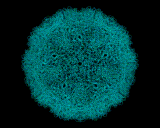 |
The image on the left shows the structure of the virus responsible for the common cold. Human rhinovirus, as this structure is known, is assembled from a collection of protein molecules surrounding a single strand of nucleic acid based genetic information. The complete virus structure is large, containing many tens of thousands of atoms and the coat structure appears almost spherical. A problem that the genetic material of a virus faces is how to cloak itself with a solid protective casing which can enclose, transport and protect the large nucleic acid polymer molecule. It takes four bases to encode a single amino acid, so it is impossible for the molecule to code for a protein which is large enough to encase the information carrier. This is a problem which bacteria, larger viruses and higher organisms have solved by making use of membranes constructed from the fruit of enzyme catalysis, but again the rhinovirus genetic material is too small to carry the information for such an enzyme. The solution is cunningly simple. The protein which is produced by the exploitation of the victim cell's protein construction apparatus is perfectly designed to assemble, like a symmetrical three dimensional puzzle, into a large composite structure. This superstructure has 60 protein molecules in an icosohedral arrangement. The icosohedron is a regular polygon, as cubes and octahedra are regular polyhedra, containing 20 equal triangles. Each triangular component of the viral icosohedron is made up of three protein molecules. The protein coat molecules are docked together as a staggeringly large collection of locks and keys to protect their genetic information store. Each joining surface of the structure dovetails with the next to close the casing structure of the virus.
Just as the virus exploits the lock and key relationship in the formation of its coating so it uses the principle both to defeat the immune system of its host and to attack its target cells. As is evident from the virus image above the coating of the virus is by no means smooth. There are clefts, raised regions which on a molecular level are mountains and valleys. It turns out that the raised loop areas rapidly change their composition as the virus progresses through successive infected individuals. It is suspected, therefore, that this chameleon-like variability allows the virus to avoid the immunity which would otherwise be built up against it by an organism's defensive systems. As anti-bodies are developed against the virus, and the highly variable regions in particular, so the the virus gradually changes its signature and consistently avoids recognition. In contrast to the variability of the raised portions of the virus coat, the valley's amino acid sequence is remarkably constant. This is interpreted as indicating that it is this region with fits a molecular lock on the surface of the victim cell. So the virus, which many molecular biologists and pharmacologists have sought to destroy through lock and key targeted drugs, turns out to be well versed in precisely this principle and efficiently exploits the knowledge in many areas, including fabricating its coat, locating its victims and evading capture.
Viruses are highly successful predators, able to adapt to the defenses of their prey. Many viruses are continually changing their outer extremities and so are undetected and yet they are able to unerringly seek out their targets through protected binding regions. Their targets, we might then infer, are some highly conserved region of the cell membrane. Perhaps a region which is encoded by more than one gene so that changes in this structure happen extremely slowly as an organism evolves. The virus can exploit this conservative vulnerability and at the same time avoid falling prey to the same defect. However, the conserved regions of the virus coat are an inherent weakness. An anti-viral drug has been shown to bind in this area for the the virus that causes the common cold.
The simplicity of viruses in comparison with bacteria might lead to their implication as stepping stone from the first molecular replicators to higher forms of life. However, the extreme dependence which viruses have on existing cells makes this unlikely. A virus needs a pre-existing cell to invade and exploit and without such a cell it cannot reproduce. So although viruses are simple, they have probably evolved after and around more sophisticated life forms.