| Su | Mo | Tu | We | Th | Fr | Sa |
|---|---|---|---|---|---|---|
| 1 | 2 | 3 | 4 | |||
| 5 | 6 | 7 | 8 | 9 | 10 | 11 |
| 12 | 13 | 14 | 15 | 16 | 17 | 18 |
| 19 | 20 | 21 | 22 | 23 | 24 | 25 |
| 26 | 27 | 28 | 29 | 30 | 31 |
As Madonna once said, 'We are living in a material world'.
And as Madonna indicates, occasionally it is interesting to reflect on the fact that the world around us is composed of molecules and atoms.
Indeed, the Greeks deduced the fact that substances must be composed of indivisible units called atoms in the sixth century BC.
However, it is sometimes hard to appreciate the importance and relevance of atoms and molecules in day to day life.
If you find yourself wondering about the immediate relevance of atoms in the world around you, take a look at a simple crystal. A diamond in a piece of jewelry, a grain of sugar, or salt has a very well defined shape. And that shape is determined by the structure of the atomic surfaces which make up that crystal.
Diamonds, sugar, and salt adopt their well defined shapes because of their regular atomic patterns. It doesn't matter how you make salt, it always makes crystals which are cubic. The well defined shapes of diamond, sugar, and all manner of crystals are a results of the well defined structures which their atoms adopt.
The image below is a view of the structure of a crystal of perovskite. Many compounds adopt the perovskite structure, including CaTiO3, BaTiO3 and MgSiO3. However, this is not an atomic level view, instead it is a view of the shape or morphology of a crystal of perovskite as you would see it in a sample of the real material.
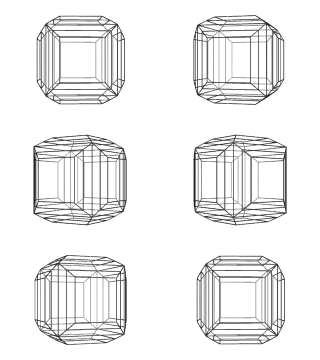
Using modeling techniques, and a knowledge of the crystal structure of perovskite, it is possible to calculate the morphology of the crystal.
Here is how atomic and molecular structure determines molecular shape. Atoms and molecules in crystals form regular packing arrangements based on inter-atomic forces. These forces cause the atoms of a given substance to always arrange themselves in a well defined structure.
However, crystals have a set of surfaces and these surfaces, for small crystals, are chosen such that the overall energy of the crystal is minimized. So the crystal favors surfaces with low energies. So the bulk packing of the atoms into the crystal and the surfaces which are seen in small crystals are those which minimize the energy of the system.
In our material world, diamonds, sugar, and salt, and all manner of materials, adopt their well defined crystal shapes as a consequence of their constituent atoms and the minimization of the energy of their systems.
In the 1960s Richard Feynman became interested in out of body experiences. Feynman had long been interested in dreams and hypnotism, and was eager to explore his brain's capabilities. So Feynman befriended an expert. On this occasion it was the Los Angeles based John Lilly. Lilly had all the equipment needed, including sensory deprivation tanks filled with Epsom Salts, and promised Feynman some interesting experiences.
However, sitting in a darkened tank of warm Epsom salts solution alone for hours on end did not achieve any unusual effects and eventually Feynman resorted to taking ketamine, the molecule you see below. He took a much smaller than normal dose and this drug kick started Feynman's ability to hallucinate.
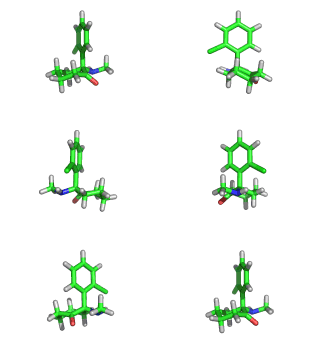
Ketamine is used as an anesthetic, it also creates a sense of separation between the mind and body. This was what Feynman duly experienced. He describes in 'Surely You're Joking Mr. Feynman!' how in the sensory deprivation tank he became dissociated from his body, feeling as though both his hands, for example, were on the same side of his self, rather than in their normal positions, one on each side.
Soon Feynman was able to hallucinate without ketamine. However, he always needed the help of the sensory deprivation tank.
What did Feynman accomplish while in an altered state of consciousness? The short answer is nothing. At one point Feynman became convinced that he had made a discovery on the way that memories are stored in the brain. However, once the hallucination (for that was all it was) had ended the emptiness of the discovery was readily apparent.
It would be interesting to know whether Feynman experienced any permanent changes as a result of taking ketamine or whether, once trained in what to expect (Pavolv style) whether strange experiences naturally followed the ritual of the sensory deprivation tank.
Feynman was always most protective of his brain, and for good reason. He had such fun thinking and solving problems that he could not bear the prospect of being separated from the device which brought him such pleasure. Feynman gave up drinking alcohol and never took LSD although he was curious about both he did not want to risk damaging his mind. The experiment with ketamine was mediated, according to Feynman, by a medical doctor. However, you can't help but think that it would have been better if he had not experimented with this perturbation to his normal brain function.
Have you ever been mesmerized by the beauty of a jellyfish? Have you ever wondered where the glow of the jellyfish comes from?
Osamu Shimomura wondered, set about finding out, and in the process changed the way that researches explore the production of proteins throughout living creatures.
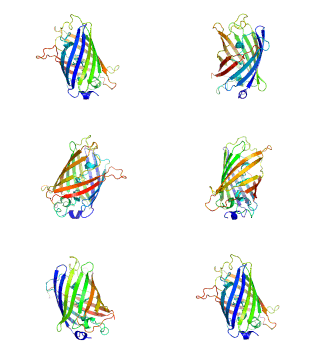
The 2008 Nobel Prize for chemistry was awarded to Osamu Shimomura, Martin Chalfie, and Roger Tsien. The molecule at the center of their prize, green fluorescent protein, also known as GFP, is shown below.
The motion of the jellyfish leads to the creation of calcium ions within the creature's cells.
The beautiful green glow of jellyfish is produced through a coupled interaction between two unique proteins.
The first, a protein named aequorin, produces blue light, when it reacts with the calcium ions released by cell motion. Then the blue light is converted to the beautiful green fluorescent jellyfish green glow by GFP.
As you can see from the image above, a GFP protein possesses a cylindrical structure. The center of the molecule contains the chemical species which convert blue light to green. This is the 'fluorophore' and it is well protected. The environment of the fluorophore has been designed by evolution to create the correct electrostatic environment and the right protection for the conversion of light from blue to green. As you might imagine for a delicate conversion, cleanliness and a high degree of control, are required.
The GFP protein is in effect a highly controlled photo-optic nano-particle which possesses the appropriate characteristics to allow it perform its assigned function. Although this might seem relatively advanced technology, GFP has been that way in jellyfish for hundreds of millions of years.
The properties of GFP allow it to be used to follow the transcription of genes. By inserting the code for GFP into a DNA sequence, researches can see when and where a given gene is active, simply by shining a blue light at the creature and watching for the characteristic jellyfish glow in response.
So ancient photo-optic nano-technology allows for the rapid analysis of biological systems!
How did the current credit crunch happen and what will its result be? Here is a simple analysis which indicates that financial meltdown has been avoided and the lessons learned will prove valuable in the future. This article was originally published on Associated Content
For the first time in many years, people in the US are worrying about the economic future of the country. The underlying reason for this worry is a realization that the secret perpetual motion engine of the economy has run short of what you might call 'fuel', for want of a better word. Here are the key steps in this critical cycle in the economic life of the nation:
1. US consumers buy foreign goods
2. Part of the profit from these sales is invested in additional foreign goods to be sold to US consumers and the remainder is invested in US financial institutions
3. The financial institutions lend the dollars to US consumers
4. US consumers buy foreign goods (that is, we return to step 1)
This is a positive feedback loop. If it were an electronic circuit it would whine. If it were a nuclear reactor, there would be a chain reaction and the nuclear fuel would be rapidly used up. However, in the case of the US economy, although the cycle has been going for many years, the effects of the positive feedback have been slow to be appreciated.
The reason for this is that loan amounts were pegged by property prices and in the US, property prices were, traditionally, comparatively low. However, with low interest rates, the amounts that mortgage companies were prepared to lend increased, and when loans increased property prices increased in tandem. Purchases then increased, the level of debt increased, and the level of foreign ownership of US financial institutions increased.
Still, all was well with the positive feedback loop of steps 1-4 for a while. And, for a while, politicians were happy to bask in the warm, but slightly worrying, glow of the feedback loop. Goods and debt were transported into the US economy, while credit and jobs were transported to foreign countries. However, US standards of living and the 'feel good' factors were rising, so there was little incentive to moderate the feedback loop.
However, the recent increase in the price of oil left US consumers struggling to pay the interest on their loans. As consumers have started to experience increasing difficulties, with almost 1 in 10 mortgage payers having a hard time making payments, the feedback loop reached a limit; it had almost consumed all of its fuel.
However, when a feedback loop such as this is discovered it can be rapidly damped. The performer points the microphone away from the speakers and the howl immediately dies down. The control rods are dropped into the reactor, each free neutron leads to the production of less than one neutron and the nuclear reaction is rapidly quenched.
The same thing happens in financial markets. Steps 1-4 have been starkly apparent to savvy politicians such as Ross Perot and Ron Paul for many years. However, now steps 1-4 are apparent to even the most superficial political performers, some of whom are in current political office, and some of whom soon will be. Accordingly, creative, if not strictly capitalist, measures are being employed to damp steps 1-4 of the economic merry-go-round. Financial institutions are being rescued rather than being allowed to fail, to the relief of nervous foreign investors. The intention is to prevent an equivalent of the South American loan fiasco that hurt many international lenders in years past.
However, there are other potentially beneficial perspectives. For example, in domestic politics, there is now, in some political circles at least, an understanding that living within the country's means and investing in education would be a useful forward looking step.
In fact, just as in our own households, there may be a realization that debt should be reserved for property and education, not satellite dishes and wide screen televisions. Hopefully the immediate spending policies for the US would be investment in programs, not necessarily academic, which drive innovation and the investment of modern infrastructure. For example, a program to reduce the cost of high bandwidth communication to every home would pay great dividends in productivity. If the politicians could avoid the temptation to legislate the maximum number of hours of YouTube watching, everybody in the country could benefit from the collective knowledge and knowledge sharing of the web, not just the spoiled middle class kids of suburbia.
A swift investment in education could be made by allowing PhD students from around the world to settle in the US on finishing their studies. These potential new recruits who have been largely fed and educated by foreign countries can then contribute to the US economy during the working lives.
So, astonishing and comically flawed as steps 1-4 may be, it appears that the US will avoid an economic disaster, learn from its dalliance with circular economics, and move on a stronger and chastened nation.