| Su | Mo | Tu | We | Th | Fr | Sa |
|---|---|---|---|---|---|---|
| 1 | 2 | 3 | 4 | 5 | 6 | 7 |
| 8 | 9 | 10 | 11 | 12 | 13 | 14 |
| 15 | 16 | 17 | 18 | 19 | 20 | 21 |
| 22 | 23 | 24 | 25 | 26 | 27 | 28 |
| 29 | 30 |
A while ago I adjusted a Zebra F701 to allow it to take a wider variety of refills. I followed the instructions in the following video:
Or - using a regular link...
https://youtu.be/5a7ed3Bk6CcThis is a fantastic video. It shows you how to disassemble the pen and modify it in various ways.
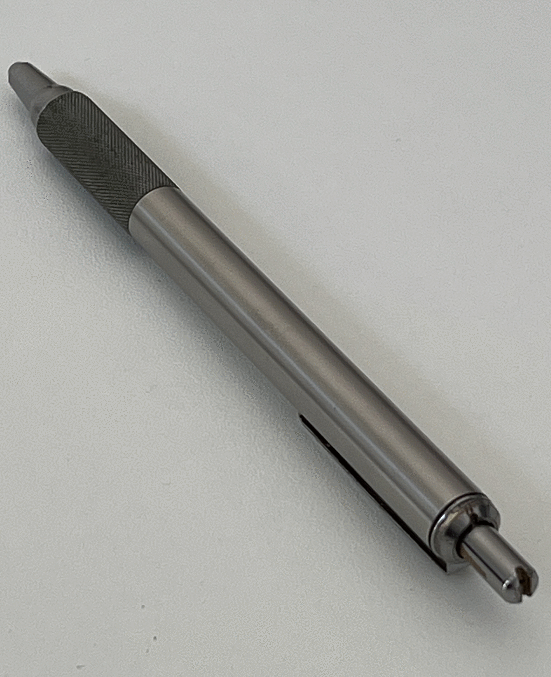
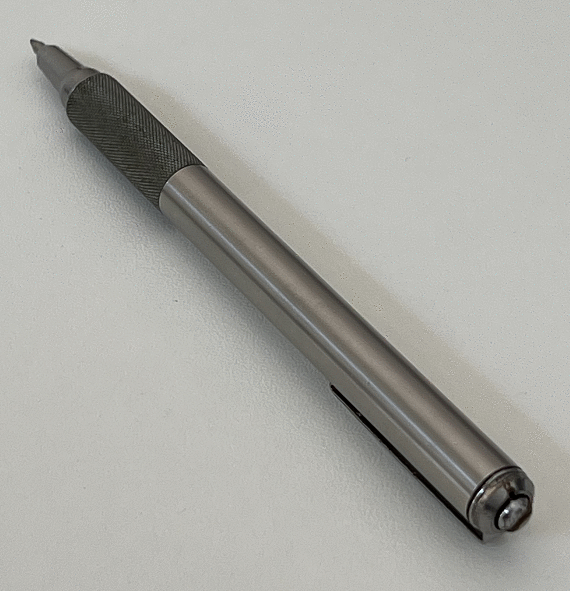
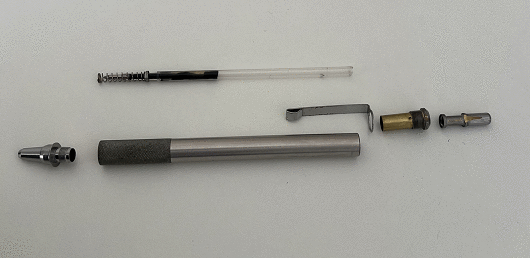
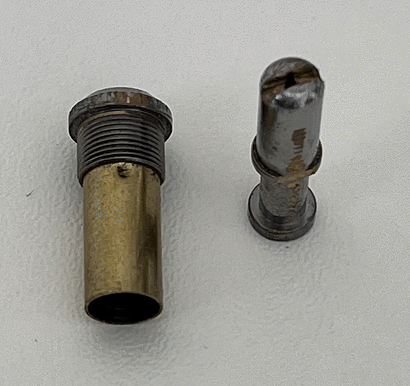
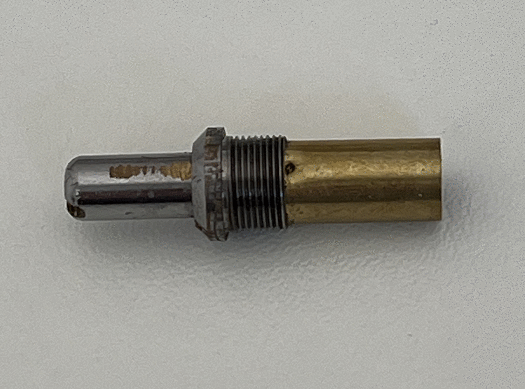
For my purposes, I simply followed the instructions to make the 'push and twist to lock' variant of this pen. This involves punching two bulges into the brass tube at the top of the pen and filling two flat spots on the pusher.
As you can see in the photographs below, I was not terrible careful in the way that i went about making the adjustments. They could be done much more neatly. The brass is quite soft, so it does not take much effort the file and saw the necessary changes.
After the changes are made, the pen can accommodate longer refills, which is very convenient. And, if anything, the changes improve the balance of the pen.
 |
 |
 |
 |
 |
Or - using a regular link...
https://youtu.be/EXJqzkWiqhUI made a 1.5 volt battery powered LED flasher last weekend - following the circuit diagram published by Burkhard Kainka (see https://www.b-kainka.de/bastel59.htm). This uses a tiny amount of current and one AAA cell last for several hundred days. It also meets the important criterion of fitting nicely into a TicTac packet - as the photograph shows.
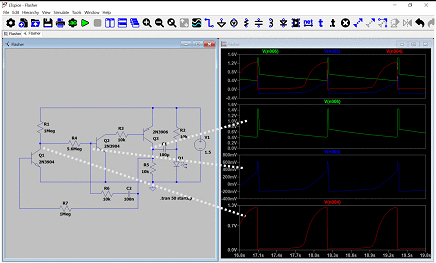
I wanted to describe how the circuit worked, so I tried using LT-Spice for the first time. Having watched a couple of YouTube videos, I felt suitably educated, downloaded the program, and gave it a go. It works very nicely. The image below shows the circuit and the LT-Spice simulation of the voltage at key points.
 |
The operation of the circuit is as follows...
To start with all the transistors are off, and the 100n capacitor is charging through R1, R4, and R6. When the 100n capacitor gets to about 0.6 volts, Q2 turns on, and turns on Q3, which is a pnp transistor. As soon as Q3 turns on, Q1 is turned on via R7, and this turns off Q2 and then Q3. So, Q3 is only turned on for a brief moment. However, Q3 being on charges the right hand side of the 100n capacitor, and Q3 turning off connects this capacitor to the negative rail. As all voltage are relative, and the 100n capacitor has its positive side connected to the negative rail, this has the effect of making the base of Q2 have a negative voltage, as can be seen in the LT-Spice simulation. Then the 100n capacitor begins to charge again, and the cycle is repeated when the base of Q2 gets to about 0.6 volts.
So that is how the circuit oscillates. The circuit is able to flash a LED, using a 1.5 volt battery, by using the oscillation in the following manner. 1.5 volts is not enough to drive a red LED, so the circuit is configured to charge up the 100uF capacitor through resistors R2 and R5, such that the right hand side of the 100uF capacitor is at +1.5 volts and the left hand side is at 0 volts. However, when Q3 opens open briefly during its oscillation cycle, the left hand side of the 100uF capacitor is connected to the positive rail, this puts the battery effectively in series with the charged up capacitor, and generates enough voltage to drive the LED giving a brief flash of the LED.
So that is how this LED flasher works. It will be very interesting to see how long it runs :-)
There are some examples on Burkhard Kainka's website of other versions of this circuit. One uses a second charge holding capacitor to increase the voltage for the LED further, so that a 1.5 volt battery can light a blue LED. I might try that next...